Images to be added soon
2020 marked the 80th anniversary of the evacuation of the British Expeditionary Force from Dunkirk. Over 300,000 troops were brought home through what must be the greatest logistical exercise of the 20th Century, mobilising suitable small craft from around the coast of Great Britain in addition to warships and larger merchant vessels. Ports around the coast of Britain will have their own story to tell, and there must be many memories of the heroism of those that took part and those that lost their lives. This article looks at the vessels built by Teignmouth's Morgan Giles shipyard that played their part in the evacuation and the Teignmouth boats that set out to assist, the outcome however was not quite as expected.
 Lady Cable loading Holiday MakersLADY CABLE is perhaps locally the most well-known of the Morgan Giles built 'Little Ships'. She is a 40ft passenger launch built in 1924 for Alf Pittaway, named after, and launched by, Lady Cable of Bishopsteignton to be used as a pleasure craft in Torquay. She was summoned to be used at Dunkirk and under the command of Lieut. B S Fidler RNVR she is said to have ferried 630 men from the beaches to the larger transport ships lying offshore. One of the last to leave Dunkirk, LADY CABLE brought another 40 men home, she is still in existence but in a very sorry state of repair.
A second Morgan Giles boat to go to Dunkirk was the 40ft motor cruiser SHELDRAKE. She was built in 1935 for Mr W J Chinneck and originally named ADRIA. In 1937 the name was changed to SHELDRAKE, owned by a Henry J Davis and still registered in Teignmouth in 1939. Renowned for her seaworthiness it would appear that she was acquired by the Admiralty early in the war who still retained possession of her in 1947. She is recorded as going to Dunkirk although there is no record of the numbers saved but she would have also been used to ferry troops to the bigger ships. After the war she changed ownership and name a number of times but is recorded as being destroyed by an explosion in 1967.
VALIANT, owned and built by Morgan Giles in 1924, was also requisitioned by the Admiralty at a later date who retained her until 1949 and renamed her ZANETTA. Shown here flying a White Ensign Valiant with White Ensign after Admiralty requisition
Just before midday on 31st May 1940 Morgan Giles received a communication from the local Coastguard Officer appealing for all suitable craft to proceed to Dover at once. There was forewarning of this requirement and Frank Morgan-Giles took this task upon himself, contacting the Naval Officer in Charge, Dartmouth to clarify the requirements. A number of local boats were turned down by Frank as being unsuitable but the following were deemed to be of suitable sea-worthiness and fuel capacity to make the trip to Dover.
These were:
HERON - a 40ft tug owned by Watts, Blake and Bearne used to pull the clay barges from Kingsteignton for loading into ships at Teignmouth Docks.
METEOR - a 32ft half-decked motor launch owned by J Broom, Pilot's Mate, 5 The Strand, Teignmouth.
SHAMROCK - a 36ft half-decked tug-launch owned by Morgan Giles Ltd.
BRITTANIA - a 35ft half-decked fishing launch, built by Morgan Giles in 1924, owned by R Matthews, Fisherman, The Strand, Teignmouth.
VALIANT - Mentioned above. A 35ft three-quarter decked passenger launch owned and used by Morgan Giles Ltd.
GOLDEN WINGS - a 35ft twin screw cutter belonging to Mrs Alice Baker of Ness House, Shaldon, designed and built in 1934 by Dixon & Sons of Exmouth.
OTTAWA - a 54ft twin screw cutter owned by Reginald Tildesley of Willenhall, Staffs. Built by McGruer & Co in 1912.
ECLIPSE - a 35ft twin screw cabin motor launch owned by Mr F L Riseley Esq. Holme Hurst, Lower Warberry Road, Torquay.
LEONID - a 42ft Auxiliary Ketch owned by Major R Rayner MP. Designed and built by Hart, Harden and Co. 1908.
By 15.00 on 31st May Frank had found crews for all eight boats and had arranged delivery of 500 gallons of petrol and 200 gallons of T.V.O. (Tractor Vaporising Oil - a mixture of petrol and paraffin). Frank then received a signal to cancel all boats neither sailed nor ready to sail. After contacting the Naval Officer in Charge he confirmed that four of the boats would set sail, the others were stood down at 16.00.
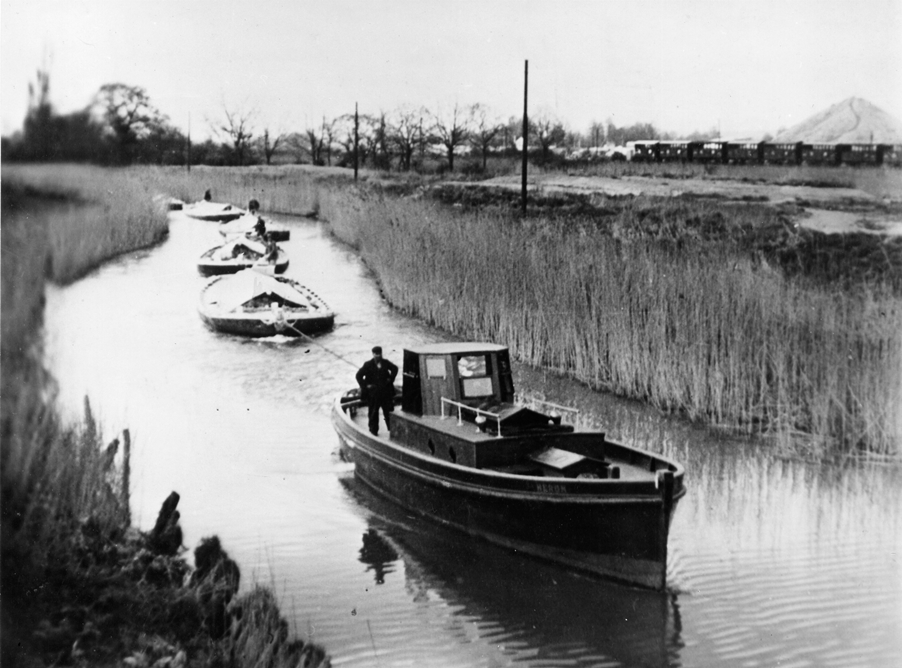 Heron at work pulling clay bargesAt 16.30 METEOR and HERON were ready for sea, METEOR, crewed by J Broom and E Roper, left Teignmouth at 17.00 followed at 17.28 by HERON crewed by F Sealey and M Hook. VALIANT had a minor defect which was repaired and sailed at 18.29 crewed by S Briggs and W P Boyne. ECLIPSE was hauled up in the Morgan Giles yard but Frank considered her to be so valuable that he sought the owner's authority to launch her. Hands worked through the night to get her ready for sea and at 03.40 on 1st June 1940 she was reported to be ready and sailed at 04.05 crewed by the Owner's own man and a Torquay engineer.
Unfortunately none of the four boats that sailed from Teignmouth to support this monumental exercise reached Dover. HERON blew an exhaust flange in the engine room off Portland and was towed into Weymouth by METEOR at daybreak on 1st June. Both vessels were detained and told to return to their home port, METEOR immediately and HERON after repairs by the local Naval Authorities. VALIANT put in at Yarmouth on the morning of 1st June to refuel and was also ordered to return, arriving back in Teignmouth later the same day. ECLIPSE reported to the guardship off Weymouth about three and a half hours after leaving Teignmouth and was detained for a couple of hours, then ordered into Weymouth and subsequently also ordered to return. She arrived at Torquay the following day. The possible reason the Teignmouth boats were ordered to return could be that by the 1st June it was expected the evacuation would come to an end that night, whereas in fact it went on for a further couple of nights.
This could well have been the end of the story but it actually continued for a further number of years, when payments for the costs of hire of boats, payments to crews and fuel and materials supplied were submitted to the Admiralty. Boats were hired at 6d per foot per day and advances to crews were made between £1 and £4. The first submission for expenses amounted to £294 19s 4d for hire and materials and £53 11s for crew payments. The Transport Office in Devonport Dockyard was chasing invoices as early as June and July 1940. It is not quite clear when these expenses were submitted but it would appear from subsequent paperwork that it was fairly quickly. Regrettably it transpired that the specific naval forms required for settlement of expenses were not completed and returned to the Devonport Transport Office, hence no payment was received at that time.
 Percival TuckerAfter the War Morgan Giles hit financial problems and in 1948 went into receivership. This was mainly due to poor bookkeeping and failure to chase payments, even dating back to work done before the war. Percival Tucker was appointed as Administrator but took it upon himself to sort out all the accounts and make the company solvent again. This he did and eventually took on the role of Accountant for Morgan Giles and became a friend of Frank's.
Percival Tucker tried to sort out many outstanding payments from the Admiralty during the war at which time over 100 vessels were built by Morgan Giles and many repairs were undertaken. One of these payments was the expenses incurred by Morgan Giles relating to the Dunkirk mobilisation. On 21st October 1948 Percival sent a letter to the Director of Naval Accounts with a copy of the original invoice asking for settlement of the account sent by Morgan Giles back in 1940. There was no answer to this until 2nd September 1949 asking for copies of letters and authorisations for the expenditures. What was available was forwarded on 5th September 1949, but it is quite understandable that the records kept at the time were sparse, considering the short timescale to prepare boats and crews, and the changing nature of orders received. No further reply was forthcoming and, after prompting, a letter was received on 8th June 1950 from the Ministry of Transport stating that they were now dealing with the claim. Further letters went back and forwards disputing claims and more requests for evidence of payments. This went on until on 5th August 1950 when the Ministry finally offered settlement of £125 due to the lack of collaborating evidence and that the claim was statute-barred due to the time elapsed.
The final letter we have available came from Percival Tucker on 3rd October 1950 stating that it seemed unfair to penalise the Company offering only £125 in settlement of instructions of the Admiralty in 1940 when every effort was made to have boats available for the Dunkirk evacuation. He made a further concession for cost of fuel that was claimed but not used in SHAMROCK and asked if the Ministry could now find it possible to forward a payable order for £200 to close the matter. Regrettably we do not know the final outcome but as mentioned earlier, Percival Tucker brought the company back into solvency and remained as the Accountant until Frank Morgan-Giles death in 1964.
We have to admire the response and the dedication led by Frank Morgan-Giles for organising the boats, the equipment required and the crews needed following the demand for vessels for the Dunkirk evacuation. We also have to have a very high regard for the bravery of those local men who volunteered to man those vessels, not knowing what dangers they were going to face.
References:
Teign Heritage Centre records.
The Evacuation of Dunkirk. Ed. W J R Gardner.
Thanks to the Morgan Giles Heritage Collection for the supply of documentation.
Photo of 'Valiant' thanks to the Viv Wilson Archive