Design Engineer

Before going into the shipyard I attended Newton Abbot College of Art and all was going well until a family crisis occurred in 1959 and I was sent out to work. My first wage was £2-15 shillings a week and after I signed my Indentures it was reduced to £2 - 9 shillings for a 48 hour week.
I was apprenticed as a Marine Engineering Draughtsman and spent the first two half years on the shop floor in various departments, starting in the fitting shop. My very first job there was to polish the bronze propellors of a 52ft Monaco Cruiser which was being readied for the International Boat Show at Earls Court in London. The firm designed and built it's own trailer to carry the boat which was to be towed by a heavy tractor, of the type that Showmen use; because of it's size and slow speed a special route had to be found to avoid low bridges and tight bends. Shipyard workers walked alongside the trailer. It took five days and countless pairs of shoes to transport the cruiser to London!
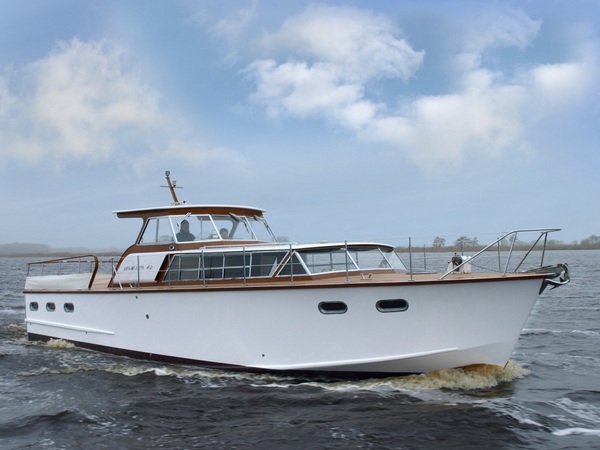 Monaco Magnet 42The Monaco Cruisers were luxury motorboats with an impressive turn of speed,built and fitted out to a high specification. They came in three lengths 36ft,42ft (later a 48ft) and 52ft and powered mainly by Caterpillar diesels.
All of the fittings and furnishings were designed and made by us, for example the double ended fridges and electrically warmed toilet seats for those with delicate posteriors. One regular customer always had swiss silk curtains, another always wanted his boat to be a foot longer than anyone else's, so a 36ft became a 37 ft & of course he would be charged for our inconvenience. However, one year this customer wanted a 42ft craft to be extended to 43ft which made life extremely easy for the design team because our 42 footer was actually 42ft - 10 and 1/2 inches long. We merely redesigned the bow roller plate out by one and half inches. I have no idea how much extra he was charged for those one and half inches!
Today I spoke with Jos Moorman in France who recently spent ten years equalling 12 thousand hours restoring a 42ft Monaco Cruiser, which I helped to design. He has done a magnificent job:
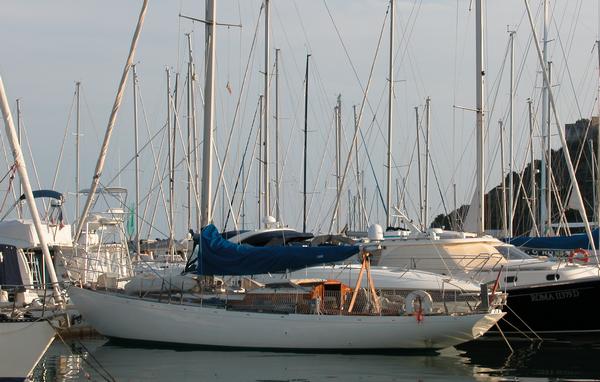 Yacht built by Morgan Giles Ltd
We also built various yachts for private owners and many types of inshore craft for the Ministry of Defence. The six years that I spent at Morgan Giles were not wasted and all that I learnt there has stood me in good stead throughout my life.
 A ketch rig yacht which I believe was built for Major Walcott of Torquay circa 1963
On the site where the shipyard once stood now stands a block of luxury apartments with superb views of the River Teign and the English Channel . I often wonder whether late at night any of the occupants hear the ghosts of the old shipyard men still working away because I often revisit the yard in my dreams.
From Melvyn Lloyd's blog The Heron's View
Mel has put together his very comprehensive memories of the yard and the people that worked there to share with us.
From my memory of Morgan Giles Ltd and the personnel who stayed in my mind:
Francis Morgan-Giles M.R.I.N.A. Managing Director: He was always dressed in the same manner, a naval officer’s cap minus gold braid, a navy blue jacket accompanied by grey cotton trousers and deck shoes. He was affectionately referred to as The Old Man, meaning the boss.
Next in line was his son Michael Morgan-Giles A.M.R.I.N.A., O.B.E who had been a Captain in the Royal Engineers. He was always known as Captain Michael and it was he who interviewed me when I applied for an apprenticeship.
Mr. Kenneth Collyer M.R.I.N.A. a Director of MG, was the firms’ senior Naval Architect. He designed the yachts and small sailing craft and was also the official measurer for various classes of yachts, sailing boats and dinghies under the R.Y.A rules. He was affectionately referred to as ‘Colly’
Working under him was Ralph Shorland M.R.I.N.A., the designer of the Monaco cruisers, a native of Dawlish and as bright as a button and much younger than Kenneth Collyer. The firm’s secretary was Lt. Commander Clayton Ret’d, who dealt with all of the business paperwork. On occasions he attempted to step up to take the helm of boats going out on trials - until stopped by the General Foreman.
Then came the Engineering Director Commander Cliff Parsons M.I.Mech.E (Mar), RN Ret’d, who was a decent sort of bloke with a keen sense of humour - which all engineers need.
Director in Charge of Stores was Brigadier Mackie, a late comer to the firm, a rather brusque type of man, who seemed not to be too familiar with stores procedures or the feelings of our longstanding Senior Storeman.
The General Foreman was George Briggs. He was in charge of the Yard and conveyed the orders of the Management to his Foremen or Chargehands. The Yard was divided into various trades each with a Foreman and/or Chargehand.
Drawing Office: The D.O. seemed to have been constructed as an afterthought and also housed the MG Offices. As a turret like structure with four half glazed walls it was perfect in springtime, awfully hot on summer days and very cold in winter. Its occupants were:
Mr K Collyer, Mr Ralph Shorland, Christopher Glatz a MG pupil A.M.R.I.N.A.(student) & Draughtsman, Stephen Kingman A.M.R.I.N.A.(student), Draughtsman MELVYN Lloyd A.M.R.I.N.A.(student) Now lapsed. N.D.D. & Draughtsman, Judith Chalmers a MG Pupil, A.M.R.I.N.A. a full time student of Naval Architecture at Newcastle College.
The Mould Loft, affectionately known as the Toy Shop, was where the hull drawings (Lines plans) were drawn out Full Size on the floor. From them the hull templates were made which gave shape to each hull. Mr Collyer was in charge of drawing out the lines and ably assisted by Lloyd Foot the toyshop resident who when not drawing lines was also the model maker. I recall that he made a wonderful model of Major Waycott’s ketch and almost every trade in the yard had an input.
The Engineering Foreman was Bill Harvey and he was in charge of the Fitters Shop, Coppersmith’s Shop, The Engine Repair Shop aka ‘The Fairmile, The Machine Shop and the Blacksmiths Shop where a solitary welder was installed. Bill was an ex-Teignmouth rugby player and like the majority of his workforce had served in the forces during the WW2 where he was a RN CPO.
His chargehand in the Fitters Shop was Norman Dawe, an 8th Army tank driver who had an injury to his right leg. In consequence he was only rarely seen afloat and stayed mainly in the workshop with his Engineering labourer, Dicky Harte. The other fitters were Vic Stud and his labourer, Frank Hutchings. The two of them generally made the fuel tanks for the Monaco Cruisers. Bob Johnson, an ex-Royal Marine, made the brass trims, wear strips and clips for the Yachts and Monaco’s. John Hambley, who joined us from a Solent yard, did the engine installations in the new craft along with his apprentice Jim Howard. Bob Ball, another fitter again an ex-Army CSM, was a very capable man and undertook all types of work from machine repairs to tool making and the installation of winches etc. I was his apprentice for a while. Finally Bert Dodds, who was in charge of the engineering store where our specialist tools and equipment were kept. There were other men who came and went.
The Coppersmiths - mentioned already was Percy Scagell, a true craftsman of the old school: a week before his retirement he made a lead pipe from a sheet of Lead and shaped it into of a half reef knot through which water was poured without any leaks. The other Coppersmiths were Alan Dove, Harry Hampson, Lionel French and Peter Symonds.
Beneath the Coppersmiths on the ground floor was The Machine Shop. The Chargehand was a man called Dennis and he had several machinists whose names now fail to register with me. It was here that the propeller shafts were cut to length and machined at either end. When shafts were very long there was a hole in the wall where the shaft went through to be supported on two bearing stands that stood in the Sawmill. MG made most of the fittings used on the boats from prop shafts, handrail stanchions to bottle screws.
On the Shaldon side of the yard was a large cradle built to hold the Fairmile Launches of WW2. At the boundary was the Engine Repair shop in which a solitary engine fitter and his apprentice worked; the Fitter was Noel Bird aka ‘Dickie Bird’. He was a character and a half to say the least. If he was holding a hammer when things went wrong, as they occasionally did, the hammer would come wildly crashing down on the nearest object. I saw him once hit the head light from the firms’ old Dodge lorry, clean off, wires and all, in one blow merely because the repaired engine failed to sit properly on its mounts. Dickie’s hobby was motorcycle scrambling and almost every weekend would be off racing across some part of Devon. One Monday morning he was late arriving at work and I sat next an engine block with an oily rag trying to look busy in case we received a visit from Bill Harvey. Suddenly I heard a noise at our double gate, so I went to investigate and there was Dickie in his van looking quite pale and swearing as he did from time to time. He said “Open the so and so gates for me to drive in and then come and help me get out. I did as he requested and supported him as he hobbled into the workshop where we had a cuppa. Afterwards he asked me to help him get as far as the main part of the yard and then leave him immediately. I did so and returned to do some valve lapping. The next thing I heard from Roy Studd was that Dickie had twisted his ankle when he fell over some carelessly left rope and Bill Harvey had driven him to the hospital. This was a prime example of how the yards’ ways and means club worked with a bit of Devonshire cunning thrown in. You see he had been barred from the yard’s Sick Club because of his many motorcycling accidents and so only an industrial accident would provide him with any money.
I know that many of the things that we did in the course of our work in the yard would now be classed today as unsafe practices. We had, apart from the Yard labourers whose foreman Was Bill Matthews aka ‘Greybeard’, a Heavy Gang made up of engineers whose job it was to move and erect a portable gantry wherever it was required. This was achieved by sheer physical labour and the ingenuity of its members, as I was tall and strong I was often roped in to help them out.
There were many other trades in the Yard:
The Sawyers - They had a large store of timber which was kept under cover in one of the large open ended sheds which allowed the wind to blow through their stacks but none of the weather. These men did the first cuts and rough shaping of the timbers which were then passed on to other wood workers for the final shaping.
The Joiners - a highly skilled team of men, seemed to always work away in silence producing exquisite furnishings from a wide variety of woods including whatever veneers the customer desired. For example, they made teak handrails, double ended fridges, boarding ladders, plush interiors such as head and wall linings, cupboards, galley benches, stairs, bunks, mattresses, cushions and venetian blinds. Their foreman was Jack Leader who I always thought had a very apt surname.
Boatbuilders & Shipwrights - Each vessel would have a Boatbuilder assigned to it who was in overall charge of everything that took place on the boat. It was he who would lay down the keel and set up the moulds (templates) at every station after having lifted them off the lines in the mould loft.
It was he who set up the centre line (a cheese wire) and similarly the shaft lines for twin engine craft. His assistants were The Shipwrights and it was they who shaped the stem, the keel and sternpost. Then used steam to shape the ribs and planks or, as in the case of the Monaco’s, the frames were laminated from strips of Canadian Rock Elm and glued together with an epoxy resin. The Shipwrights also set and fixed the longitudinal members and the engine bearers as well as shaping and fitting the planking. They also fitted the upper works such as cabin sides, coach roofs, decking and rubbing strakes.
Painters - When a craft was near to completion the painters would start preparing the hull by stopping up any hollows with filler and sanding them down to a smooth surface before applying the first of many undercoats. Each coat was allowed to dry before the final three coats of enamel top paint was added to give a mirror like finish.
The Rigger - We only had one rigger Bill (?) aka Bill the Rigger who worked alone in his own loft and made up all of the wires and cables that were required for each craft. His loft was a cosy place to visit if you could manage to skive off for a few minutes on a cold morning, he always enjoyed having a chat with anyone who dropped in. The trouble was it was also one of the occasional roosts of the General Foreman, George Briggs too, so you had to have an excuse ready as to why a lowly apprentice was visiting Bill the Rigger.
Electrician/Welder - Most of the electrical work was put out to contract to JB Marr & Co, even though we did have a maintenance electrician. He did not appreciate going afloat however, after an accident when he was blown into the water when working on a barge and the earth lead fell off when some welding was being done! Another man who mainly worked alone in his own workshop, was Bill the Welder. His place had a coal forge at one end with all of the implements and tools required, complete with a cast iron cone and anvil. Bill could always be found sitting at his bench with a large flask of tea and his Daily Mirror by his side and because of the fumes, he was provided with a pint of milk per day by the firm. He was an excellent welder of steel and aluminium plus any intricate silver soldering that was required for various bits and pieces. One problem, that affected most of us, was when Bill started arc welding without giving any warning giving us all ‘arc-eye’. It felt like having sharp sand in your eyes.
The Boatman - Sometimes boats that needed work done on them were moored in the river close by the yard and Jim the Boatman ferried us out in the yard boat, an eighteen foot clinker built craft powered by an 8HP Seagull outboard motor. On occasions when a lot of men with tool bags and parts were being carried, we all stood up and the freeboard would only be about three inches instead of the normal fifteen inches. It often seemed to be very precarious for none of us were wearing any life preservers and fortunately there was never an accident.
The Driver - Roy Studd (son of Vic Studd mentioned above) was the driver of the firms’ lorry and also the MG van. He would be sent off to various firms to collect parts and equipment, for example he went to the Exeter Foundry for the MG designed rudders, the bow plate and other bits and pieces which would be in a raw state and needing the rough edges removed before being sent off to be chrome plated in Torquay.
It is worth remembering that the workforce of Morgan Giles Ltd were a highly skilled team of people, who took a great deal of pride in their work and were the envy of a great many firms in the UK and they were not necessarily those involved in the marine industry. As a consequence of this when the yard finally closed very few of employees found themselves out of work. In my later life I had only to mention where I had been trained for doors to be opened and this was particularly so when I went for an interview with the MOD(N) to be engaged as a sub contract draughtsman, the said sub contract lasted for approximately ten years.
Abbreviations used
RN Royal Navy
CPO Chief Petty Officer
O.B.E. Order of the British Empire
M.R.I.N.A. Member of the Royal Institute of Naval Architects
A.M.R.I.N.A. Associate member.
M.I.Mech E.Mar. Member of the Institute of Mechanical Engineers -Marine.
N.D.D. National Diploma of Design.
Please note that none that is written here has ever been published by me nor have I copied anything from other manuscripts.
© Melvyn R Lloyd 14th March 2018
Melvyn Lloyd
Republic of Ireland.